
What Is Flexible Packaging and Why Can’t I Recycle It?
If you’ve ever stood at your kitchen bin holding an empty coffee pouch, snack packet or pet food bag and wondered, “Why can’t I just put this in the recycling?”, you’re certainly not alone.
It looks like plastic. It feels like plastic. And there may even be recycling or sustainability claims printed on the pack.
So why is flexible packaging recycling so complicated?
I’ve spent more than 40 years working with flexible packaging, and the answer is not as simple as saying that flexible packaging is good or bad, recyclable or non-recyclable.
To understand the problem, we first need to understand what flexible packaging actually is – and what we need it to do.
What is flexible packaging?
Flexible packaging is packaging made from materials that can bend, fold or change shape rather than remaining rigid.
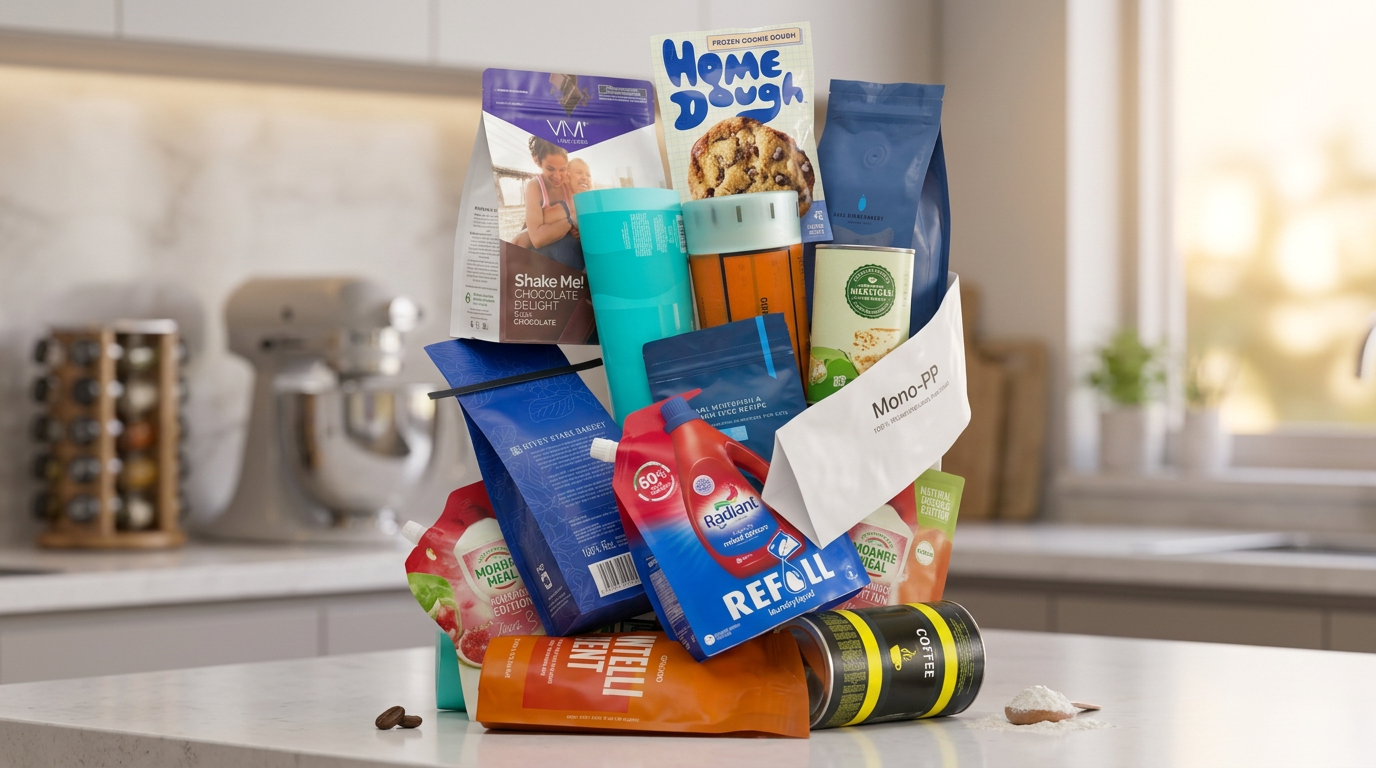
Think of the everyday products around you: coffee bags, pouches, confectionery wrappers, frozen-food bags, pet food packaging and countless other packets, sachets and films.
Unlike a glass bottle, metal can or rigid plastic container, these packs use relatively lightweight flexible materials to contain and protect a product.
But what looks like one simple piece of plastic may actually be a highly engineered packaging structure.
Depending on what the product requires, flexible packaging materials can include combinations of polyethylene (PE), polypropylene (PP), polyester (PET), nylon, aluminium foil, paper and bio-based materials, along with inks, coatings and adhesives.
There is a reason for that complexity.
Flexible packaging has a job to do.
One point I made recently in my article for PKN Packaging News is something I believe our industry needs to keep coming back to:
Packaging has one primary job: to protect the product.
That sounds obvious, but it is surprisingly easy to forget when so much of today's packaging conversation is focused on sustainability.
For food in particular, packaging can be responsible for protecting a product from oxygen, moisture, light and contamination. It may need to survive manufacturing, filling, sealing, transportation, warehousing and retail before it ever reaches your kitchen.
It can also play an important role in achieving the required shelf life.
That is why flexible packaging has become so technically sophisticated.
Different materials can provide different properties. Combining them can create a pack with the particular barrier, strength, sealing and processing characteristics a product requires.
And therein lies one of our biggest recycling problems.

Why can't I recycle flexible packaging?
Because collecting something is not the same as recycling it.
And being theoretically recyclable is not necessarily the same as being practically recyclable within the system where you live.
For recycling to work, we need a functioning chain.
The packaging needs to be collected, then sorted, then processed into usable recycled material. Someone then needs to turn that material into another product – and, importantly, there needs to be a viable market for that product.
If one part of that chain doesn't work, we don't have a truly circular system.
Australia still has significant gaps in its plastic recycling system, particularly when it comes to flexible packaging and soft plastics.
As I discussed in my August 2026 PKN article, some very important questions remain: how do we collect soft plastics at scale? How do we recycle them economically and consistently? And what are the viable end markets for the material we recover?
Those are much harder questions than simply putting a recycling symbol on a packet.
The materials make a difference, too.
Another challenge is that not all flexible packaging is made from one type of plastic.
A pack might contain several different materials laminated together because each layer is performing a particular function.
That can be excellent from a packaging performance perspective.
From a recycling perspective, it can be extremely difficult.
If you've combined polyethylene, polyester, nylon, aluminium foil, inks, coatings and adhesives to produce a high-performance pack, separating those materials into useful recycling streams is no simple task.
This is one reason there is so much interest in mono-material flexible packaging.
So, why don't we just make everything mono-material?
Moving towards mono-material structures is an important direction for the flexible packaging industry.
But this is where I think we need to be careful.
Changing a package isn't simply a matter of swapping one material for another and calling the result sustainable packaging.
The new structure still has to work.
Does it provide the required barrier?
Will it run properly on the customer's machinery?
Will it seal reliably?
Can it withstand transport and storage?
Does it maintain the required shelf life?
Is it suitable for direct food contact?
What happens to the product if it doesn't perform?
Those questions matter because a packaging failure can mean spoiled food, wasted product, rejected stock, production problems and potentially much bigger environmental and commercial consequences.
This is why I am cautious when I see bold sustainability claims that aren't accompanied by enough technical detail.
Sustainable flexible packaging still needs to be fit for purpose.
Recyclable doesn't necessarily mean recycled.
This is an important distinction for consumers and businesses alike.
When somebody describes packaging as “recyclable”, it's worth asking what that actually means.
Can it technically be recycled under certain conditions?
Or is there an established collection, sorting and recycling system available to the people actually buying the product?
And once it has been recycled, is there a genuine market for the resulting material?
Those are very different propositions.
We have seen considerable investment and development in soft-plastics recycling in Australia. But technology alone doesn't close the loop.
As I wrote in PKN, producing recycled granules or another recovered material is only part of the equation.
We also need somewhere useful for that material to go.
Without viable end markets, circularity remains incomplete.

What about chemical recycling and recycled content?
This is another area where businesses need to look beyond the headline.
There are claims being made around recycled content in flexible packaging using approaches including mass balance, advanced recycling and chemical recycling or pyrolysis.
These are complicated areas.
They shouldn't automatically be dismissed, but nor should a business accept a simple marketing claim without understanding what sits behind it.
What material is actually being recovered? How is recycled content being calculated or attributed? What process is being used? What evidence supports the environmental claim?
If your brand is going to put a sustainability statement on thousands or millions of packs, these aren't trivial questions.
They're part of responsible packaging sourcing and specification.
We need to stop starting with the word “sustainable”.
This may sound strange coming from somebody who has advocated for more sustainable packaging for many years.
But when a business comes to me and says, “We need sustainable packaging,” my first question isn't, “Which sustainable material would you like?”
I want to understand the product.
What are we packing?
What shelf life does it need?
What barrier properties are required?
How is it filled?
What machinery is being used?
How will it be transported and stored?
What food-safety requirements apply?
What does the consumer need from it?
And what happens at the end of the package's useful life?
Only once we understand those requirements can we properly evaluate the available sustainable packaging solutions.
As I wrote in PKN, doing it the other way around is putting the cart before the horse.
Better packaging starts with better questions.
There isn't a single material that will solve every flexible packaging problem.
And there isn't one sustainability claim that tells you whether a package is genuinely the right choice.
What we need is a more informed conversation.
For consumers, that means greater clarity about what packaging is made from, what recycling claims actually mean and what happens after we dispose of it.
For brand owners, retailers and packaging buyers, it means looking beyond the sales pitch.
A good flexible packaging supplier should be able to explain why a particular structure has been recommended, what performance it provides, where its limitations are and what evidence sits behind its sustainability claims.
After more than four decades in this industry, my approach remains quite simple:
Start with the product. Design packaging that performs. Then make it as sustainable as technically and commercially possible.
That might not fit neatly into a sustainability slogan.
But I believe it's a much better foundation for moving flexible packaging forward.
Need independent advice on your flexible packaging?
Choosing the right flexible packaging involves far more than comparing specifications or finding the lowest unit price.
Material structure, barrier performance, machinery, shelf life, food safety, sourcing, quality, recyclability and commercial reality all need to work together.
I work with brand owners, packaging buyers and businesses to help them understand those decisions, challenge supplier claims and identify flexible packaging solutions that are genuinely fit for purpose.
If you're reviewing an existing packaging format, considering a more sustainable structure or simply want an experienced, independent view before making your next packaging decision, get in touch.

Joe Foster
Flexible Packaging Consultant
40+ years' experience in flexible packaging, sourcing and sustainability